
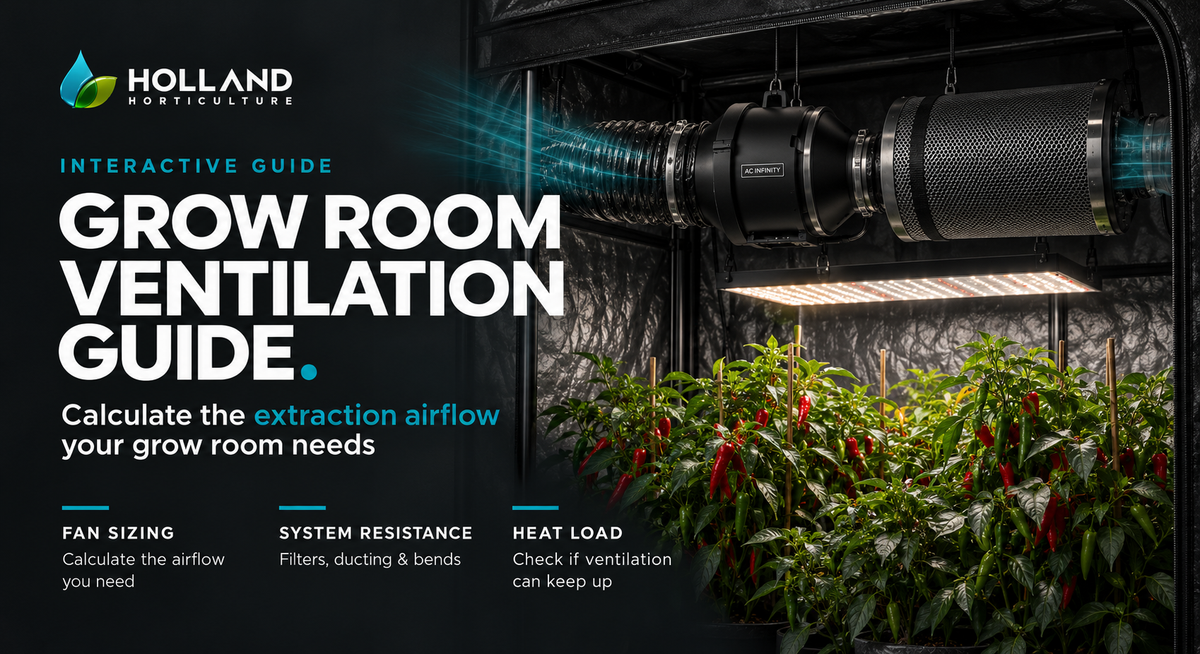
Choosing an extraction fan by duct diameter alone can leave a grow room short of real airflow. Room volume matters, but so do carbon filters, duct length, bends, available intake air and the heat produced by equipment inside the space.
This guide explains how to size grow-room ventilation as a complete system. Use the calculator below for a practical starting point, then work through the guide to understand why the result changes once a fan is connected to a filter and ducting.
Estimate the free-air fan capacity your room may need after allowing for air exchange, system resistance and optional heat load.
Advanced heat & air-exchange check
Estimated system restriction: 26%. Look for a controllable fan rated at or above the recommendation, then confirm performance against the manufacturer’s airflow-versus-static-pressure data where available.
For passive intake, provide generous low-level intake area and aim for slight negative pressure when the extraction fan is running.
This is an estimated fan rating, not guaranteed installed airflow. Filters, duct diameter, fittings, fan design and intake restriction all affect real performance.
Guidance only. The calculator uses practical allowances for filters, ducting and bends. For critical or complex installations, size against the fan manufacturer’s pressure/airflow curve and the resistance data for the connected components.
What Does Grow Room Ventilation Actually Do?
Ventilation replaces air inside the growing space. An extraction fan removes warm, moisture-laden air while intake openings or an intake fan allow replacement air to enter.
This is different from circulation. A circulation fan moves air around the plants but does not remove the total heat or moisture load from the room. For fan placement inside the canopy, read our Grow Room Airflow Guide.
How To Calculate Grow Room Volume
The first calculation is simple:
Length × Width × Height = room volume
A 1.2 m × 1.2 m × 2.0 m tent has a volume of 2.88 m³.
If the target is one complete air change each minute, multiply the room volume by 60 to convert it to an hourly airflow requirement:
2.88 × 60 = 172.8 m³/h
That is the base air-exchange requirement before allowing for filters, ducting, bends or heat load.
How Often Should The Air Be Exchanged?
There is no single exchange rate that suits every room. Smaller enclosed spaces with strong lighting, high plant transpiration or limited temperature control may need more frequent exchange than a cool, lightly loaded room.
The calculator defaults to one air change per minute because it provides a useful practical starting point for an actively lit indoor growing space. The Advanced section lets you compare slower exchange intervals where conditions allow.
Why The Fan Rating Is Not The Same As Real Airflow
Extraction fans are commonly advertised using a maximum airflow figure measured under low or zero external pressure. Once the fan is connected to a carbon filter, ducting and fittings, the system creates resistance.
As resistance rises, installed airflow normally falls. The exact reduction depends on the fan design and its performance curve, which is why two fans with the same advertised maximum airflow can behave differently when connected to the same system.
Carbon filter resistance
A carbon filter adds resistance because air must pass through the filter body and carbon bed before reaching the fan. A clean, correctly sized filter creates less difficulty than an undersized or heavily loaded filter, but it should still be allowed for during sizing.
The calculator uses a practical estimated allowance rather than pretending every filter behaves identically.
Duct length
Longer duct runs increase friction. Flexible ducting usually creates more resistance than smooth rigid duct because of its internal ribbed surface. Keep runs as short and straight as the installation allows.
Bends and fittings
Each sharp bend changes airflow direction and adds further resistance. Several tight 90° bends can make a substantial difference to real performance, particularly in smaller-diameter systems.
| System feature | What it changes | Good practice |
|---|---|---|
| Carbon filter | Adds pressure resistance | Match the filter diameter and suitable airflow range to the fan |
| Flexible ducting | Higher friction than smooth duct | Keep it short, fully extended and free from crushing |
| 90° bends | Increases turbulence and resistance | Use gentle routing and reduce unnecessary bends |
| Small intake area | Starves the extractor of replacement air | Provide adequate passive or active intake |
| Dirty filter / blocked duct | Raises resistance over time | Inspect and maintain the system regularly |
Heat Load: The Check Most Simple Fan Calculators Miss
Room volume alone does not tell you whether ventilation can remove the heat produced by lighting, drivers, pumps and other equipment.
The Advanced Heat Check estimates the airflow needed to carry sensible heat away using the difference between incoming-air temperature and the maximum room temperature you are prepared to accept.
If the heat-removal requirement is higher than the basic air-exchange requirement, the calculator uses the larger figure before allowing for system resistance.
Passive Intake Vs Active Intake
Every litre of air extracted from the room needs replacement air. If the intake is too restrictive, the extraction fan has to work against additional pressure and the real airflow can fall.
Passive intake
Passive intake uses vents or openings rather than a powered intake fan. It is simple, quiet and often suitable for compact grow tents when the available intake area is generous enough.
Active intake
An active intake fan pushes replacement air into the room. This can help larger spaces or installations where the intake path itself is restrictive. Keep the intake airflow slightly below extraction so that the room maintains a small amount of negative pressure where appropriate.
What Is Negative Pressure?
Negative pressure means slightly more air is being extracted than supplied. In a fabric grow tent, the walls may pull inward slightly when the system is balanced this way.
This helps encourage air to enter through the intended intake points rather than leak outward through every gap. It is especially useful when the extracted air passes through a carbon filter.
Change the system configuration to see how additional components increase estimated resistance through the airflow path.
Where Should Extraction And Intake Be Positioned?
Extraction is normally positioned toward the upper part of the growing space because warm air tends to collect higher in the room. Intake is generally positioned lower and, where possible, away from the extraction point so replacement air travels through the growing area before leaving.
Inside the canopy, use separate circulation fans to mix air rather than relying on the extraction system alone. Our fan placement and air-circulation guide covers that side of the setup in more detail.
How Ventilation Affects Temperature
Ventilation removes heat by replacing warmer room air with incoming air. Its cooling ability is therefore limited by the temperature of that incoming air.
If a grow room is overheating, check the complete system rather than simply increasing fan speed: filter sizing, duct restriction, intake supply and the location of the intake air can all affect the result.
For a broader environmental approach, read our Grow Room Temperature Guide.
How Ventilation Affects Humidity
Plants add moisture to the room through transpiration. When the incoming air is drier than the room air, ventilation can remove some of that moisture and help prevent humidity from continually building.
However, extraction is not a universal dehumidifier. If the replacement air is already humid, increasing airflow may have limited effect on relative humidity. Read our Grow Room Humidity Guide for a more complete explanation.
Ventilation During Lights Off
Ventilation demand does not disappear when the lights switch off. Heat load normally falls, but plants and wet growing media can continue releasing moisture. At the same time, falling temperature can push relative humidity upwards.
Instead of switching extraction off automatically, many rooms benefit from maintaining a controlled minimum airflow and allowing a compatible environmental controller to increase fan speed when temperature or humidity moves away from the desired range.
Common Grow Room Ventilation Mistakes
Sizing from duct diameter alone
A 150 mm fan is not automatically suitable for every room using 150 mm duct. Compare actual airflow capacity and system pressure performance.
Ignoring the filter
A fan that looks adequate on paper may become marginal once a restrictive carbon filter is installed.
Using too much flexible duct
Long, compressed or sharply bent flexible duct can reduce useful airflow significantly.
Undersizing the intake
A powerful extractor cannot move its rated airflow if replacement air cannot enter the room freely enough.
Assuming more extraction is always better
Excessive ventilation can make heating and humidity control harder, particularly during colder weather.
Ignoring real room conditions
Use temperature and humidity measurements to confirm whether the installed system is actually achieving the intended environment.
Grow Room Ventilation Checklist
Choosing Your Extraction Fan
Once you have an estimated target, choose a fan that can meet the required airflow while connected to the rest of the system. A controllable fan with some sensible headroom is usually more useful than selecting a fan that only just meets the calculation at full power.
Also check:
- duct and filter diameter compatibility
- noise requirements
- AC or EC motor type
- controller compatibility
- available pressure/airflow performance data
- power consumption and expected running time
Build the rest of the ventilation system
Compare extraction fans, carbon filters and compatible fan controllers from Holland Horticulture.
Frequently Asked Questions
What size extractor fan do I need for a grow tent?
Start with the tent volume and desired air-exchange interval, then allow for the restriction created by the carbon filter, ducting and bends. The calculator above gives a practical free-air fan-rating estimate rather than sizing from duct diameter alone.
Should I oversize my extraction fan?
Some headroom is useful because installed airflow is normally lower than the fan’s unrestricted maximum. A controllable fan slightly above the calculated requirement is often more flexible than a fan that must run at full output continuously.
Does a carbon filter reduce airflow?
Yes. The filter adds resistance to the system, so real airflow will generally be lower than the fan’s free-air rating. The exact reduction depends on the filter and fan combination.
Is passive intake enough?
It can be for many compact grow tents if the intake area is generous and unrestricted. Larger or more restrictive installations may benefit from an active intake fan.
Can ventilation cool a grow room below outside temperature?
Not reliably using air exchange alone. Ventilation can move the room temperature toward the temperature of the incoming air, but cooling below that normally requires a cooler intake source or active cooling.
Should extraction stay on when the lights are off?
Some air exchange is often still useful because plants and wet media can continue adding moisture while falling temperature can increase relative humidity. The appropriate minimum airflow depends on the actual room conditions.
This guide is intended as practical horticultural guidance rather than a substitute for a commissioned ventilation design. Large rooms, unusual duct systems, high heat loads or installations with strict pressure requirements should be checked against manufacturer fan curves and component pressure data.