
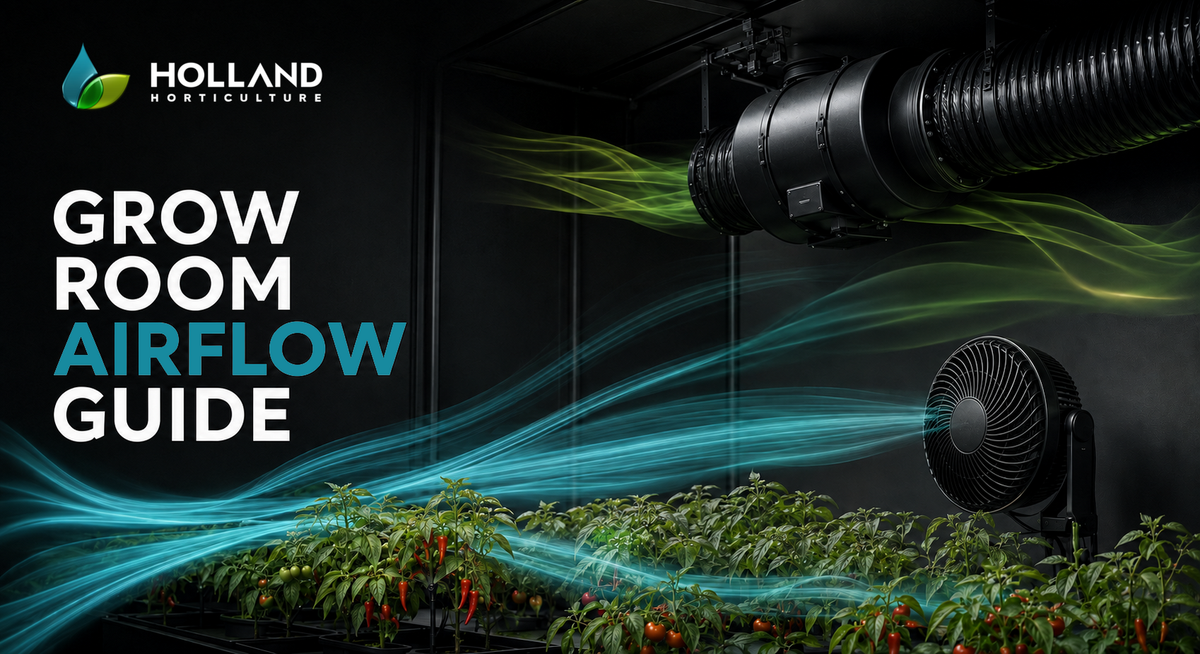
Airflow is one of the easiest parts of an indoor growing environment to underestimate. Temperature can look right. Relative humidity can be within range. Your VPD can appear well controlled. But those measurements do not necessarily tell you what is happening between the leaves.
Dense foliage can create pockets of still, humid air. Heat can build in one part of the growing space while another area remains cooler. Simply pointing a powerful fan directly at the plants is not the answer either.
Good grow-room airflow is about creating gentle, distributed air movement throughout the growing space. The aim is not to make plants fight against a fan. It is to reduce stagnant areas, mix the air around and beneath the canopy, and help the environment remain more consistent.
Why Air Movement Matters
Air does not remain perfectly mixed around a plant canopy. Leaves interrupt its movement, dense growth creates sheltered pockets and equipment can create localised warm areas. Without sufficient circulation, the conditions measured by a sensor elsewhere in the room may not accurately represent the microclimate inside the canopy.
Circulation Fans vs Extraction Fans
These two jobs are related, but they are not interchangeable.
Extraction removes warm, humid or stale air from the growing space and normally draws replacement air in through an intake. Circulation moves the air that is already inside the space.
A grow tent can therefore have strong extraction and still contain poorly mixed areas inside a dense canopy. Likewise, several circulation fans cannot compensate for inadequate air exchange where extraction is required.
What Should Good Airflow Look Like?
Plant leaves should show gentle movement rather than being continuously battered in one direction. Air should reach the canopy from more than one area, and dense plants may benefit from movement below the canopy as well as above it.
Think about distribution rather than raw fan power. Two sensibly positioned fans operating gently can often create a more even pattern than one powerful fan aimed directly at the centre of the crop.
Airflow Setup Builder
Choose the closest description of your growing space. This tool gives a practical circulation starting point rather than an exact airflow requirement.
How to Position Circulation Fans
A fan does not need to point directly at the plants to be useful. In many setups, aiming airflow across the canopy or toward an opposing wall creates broader air movement and avoids concentrating all of the fan's output on the nearest leaves.
Above-Canopy Airflow
Positioning a fan around canopy height or slightly above it can help move warm air away from the upper foliage and mix air across the growing area. Avoid placing a powerful fan extremely close to one plant.
Below-Canopy Airflow
As plants become larger and foliage becomes denser, the space beneath the canopy can become increasingly sheltered. A lower fan operating gently can help keep this area connected to the rest of the room's air movement.
Use More Than One Direction
Where the space and equipment allow, distributing fans around different sides of the growing area generally creates a more useful circulation pattern than having every fan blow in exactly the same direction.
Fan Placement Visualiser
Change the number of circulation points and highlight potential sheltered areas. This is a conceptual visualisation — real airflow depends on the room, plants and equipment.


1 FAN
Focused circulation
How Many Circulation Fans Do You Need?
There is no universal fan count that works for every grow room. Fan size, fan speed, tent dimensions, plant height, canopy density, extraction layout and obstructions all change how air actually moves.
For that reason, it is better to treat fan quantity as a starting point to be assessed rather than a fixed formula. Begin with enough circulation to create gentle movement across the growing area, then inspect the canopy for sheltered areas and excessive direct airflow.
Finding Dead Zones
A dead zone is an area where air movement is noticeably weaker than the surrounding space. Corners, areas behind equipment and the interior or underside of a dense canopy are common places to investigate.
Check different areas of the growing space rather than assuming that movement near the fan means the entire canopy is receiving useful circulation. Compare temperature and humidity readings from different positions if you suspect the environment is uneven.
Can You Have Too Much Airflow?
Yes. More air movement is not automatically better. Leaves that are constantly pushed hard in one direction, plants nearest the fan showing noticeably more stress than the rest of the canopy, or foliage being physically battered are signs to reconsider fan speed, distance or direction.
Often the solution is not to remove circulation altogether, but to spread it more evenly: reduce fan speed, increase distance, redirect the fan across the space, or use multiple gentler circulation points.
Airflow Problem Diagnoser
Choose the symptom that most closely matches what you are seeing.
Airflow When the Lights Are Off
Air circulation still matters after the lights go off. As the growing space cools, relative humidity can rise even when the amount of moisture in the air has not increased. Dense foliage can make localised humidity especially important to watch.
Maintaining sensible circulation can help mix those local pockets, but circulation cannot remove moisture from the room. If lights-off humidity is too high, the wider humidity and extraction strategy also needs attention.
How Airflow Connects to Temperature, Humidity and VPD
Airflow should not be treated as an isolated setting. Circulation helps mix heat and moisture around the growing space. Extraction changes the air itself. Together, these influence the temperature and relative humidity experienced around the leaves — the same environmental variables used when considering VPD.
Common Grow-Room Airflow Mistakes
Grow-Room Airflow Checklist
Build a More Consistent Growing Environment
Good airflow is not about creating a wind tunnel. It is about keeping air moving gently and consistently around the plants so that the growing environment behaves more like one controlled space and less like a collection of separate microclimates.
Start with sensible fan placement, observe the canopy, check sheltered areas and adjust the system as the plants grow. As canopy density changes, your airflow strategy may need to change with it.
For the complete environmental picture, use this guide alongside our VPD Guide, Grow Room Humidity Guide and Grow Room Temperature Guide.