
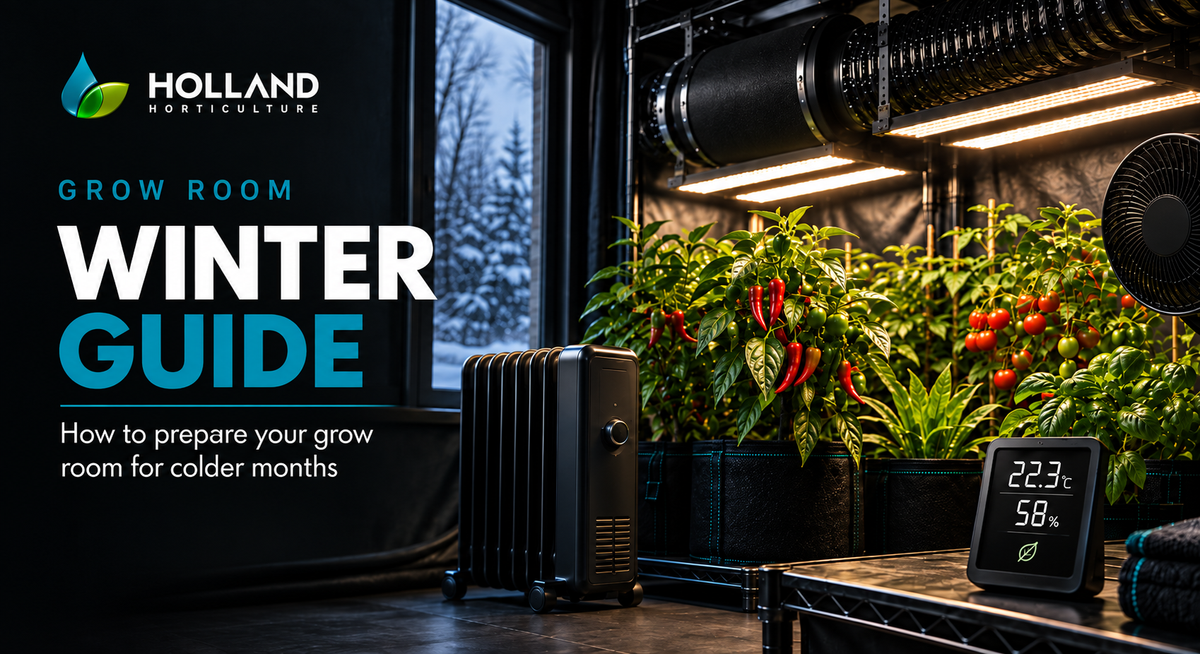
Winter can completely change the environment inside an indoor grow room.
Lower outdoor temperatures, colder intake air, unheated buildings and longer periods of low ambient temperature can all affect how your growing space behaves — particularly once the grow lights switch off.
A grow room that remained stable throughout summer can suddenly begin experiencing sharp temperature drops, rising relative humidity, cold root zones and condensation as autumn moves into winter.
The answer is not simply to add more heat. Successful winter growing is about balancing temperature, humidity, ventilation, air movement and heating so that the environment remains as stable as possible throughout the complete light and dark cycle. In this guide, Holland Horticulture explains how to prepare an indoor grow room for winter, what to monitor, where heat is commonly lost and how to create a more controlled environment during colder UK weather.
Why Does Winter Affect Indoor Grow Rooms?
Even when plants are being grown indoors, the outside environment still has an influence.
Air entering through passive intakes, active intake systems, open doors and ventilation systems will normally reflect the conditions surrounding the growing space. During winter, that incoming air can be considerably colder.
Grow lights and other equipment may generate enough heat to compensate while the lights are operating. Once those lights switch off, however, one of the main sources of heat can disappear very quickly.
This is why many winter grow-room problems become most noticeable during the lights-off period.
The surrounding building also matters. A grow tent inside a heated room behaves very differently from a grow tent positioned inside an unheated garage, loft, shed or outbuilding.
Cold concrete floors, external walls and poorly insulated spaces can continually draw heat away from the growing environment.
The objective during winter should therefore be environmental stability, rather than simply achieving a particular temperature at one moment in the day.
Monitor Both Lights-On and Lights-Off Temperatures
Looking at the temperature while the grow lights are operating only tells part of the story.
The lights-off temperature can be equally important.
When the main lighting system switches off, the air temperature can begin falling rapidly. If the surrounding room is already cold, the drop can be even more pronounced.
A digital thermometer, temperature controller or environmental controller capable of recording minimum and maximum values makes it much easier to understand what happens while the grow room is unattended.
Instead of simply asking:
“What is my grow-room temperature?”
It can be more useful to ask:
“How much does my grow-room temperature change over the complete 24-hour cycle?”
A growing environment that remains relatively stable is generally easier to manage than one constantly moving between very different conditions.
If your temperatures fall sharply after the lights switch off, controlled heating, changes to extraction or reducing unnecessary heat loss may need to be considered.
For a more detailed explanation of temperature management, read our Grow Room Temperature Guide.
Why Temperature Drops Can Increase Relative Humidity
Temperature and relative humidity are closely connected.
As air cools, its capacity to hold water vapour changes. This means relative humidity can rise even when no additional moisture has entered the grow room.
This is one reason growers sometimes see humidity increase shortly after the lights switch off.
At the same time, plants, growing media and irrigation systems can continue adding moisture to the environment.
A cold grow room combined with high relative humidity can therefore become more difficult to control than either problem on its own.
Cold walls, ducting, tent surfaces and other equipment can also approach the dew point. If a surface becomes sufficiently cool, moisture can begin condensing onto it.
Rather than treating temperature and humidity as completely separate problems, winter environmental management should consider the relationship between the two.
If humidity is becoming difficult to control, our Grow Room Humidity Guide explains relative humidity, dew point, ventilation, circulation and moisture removal in more detail.
Use Controlled Heating Rather Than Constant Heating
Adding a heater can be an effective way to stabilise an excessively cold grow room, but simply leaving a heater operating continuously is rarely the most controlled approach.
Where possible, heating should respond to the actual environment.
A thermostat, environmental controller or heater with integrated temperature control allows heating to operate when required and reduce or stop its output once the desired temperature has been reached.
This can help reduce large temperature swings while avoiding unnecessary heat.
There are several types of heating commonly used around indoor growing environments.
Tube Heaters
Tube heaters provide relatively gentle background heat and can be particularly useful in smaller spaces or environments where only a modest amount of additional heating is required.
They can work well where the objective is to reduce a small lights-off temperature drop rather than rapidly heating a large cold room.
Oil-Filled Radiators
Oil-filled radiators provide slower, sustained heating.
Because the radiator body retains heat, they can be useful for larger rooms or environments where steady background warmth is required.
Using an oil-filled radiator with suitable thermostatic control can provide considerably more consistent environmental management than relying on manual switching.
Fan and PTC Heaters
Fan heaters and modern PTC grow-room heaters can increase air temperature more rapidly.
Some modern grow-room heating systems can also integrate directly with environmental controllers, allowing heating output to respond automatically to temperature readings and environmental conditions.
Whatever type of heater is used, always follow the manufacturer's installation and safety instructions.
Heating equipment should be positioned appropriately and kept away from water, irrigation equipment and anything that could restrict safe airflow around the unit.
Pay Attention to the Lights-Off Transition
The transition between lights-on and lights-off is often where the largest environmental change occurs.
When powerful grow lights shut down, the heat they were producing can disappear almost immediately.
This can cause temperature to fall while relative humidity begins to rise.
Rather than waiting until the grow room has already become excessively cold, a suitable environmental-control system can help compensate as conditions change.
The objective is not to make the grow room excessively warm during the dark period.
It is to reduce unnecessary environmental swings.
The more stable the transition between the light and dark periods becomes, the easier it usually becomes to manage temperature and humidity together.
Don't Ignore the Root Zone
Air temperature receives most of the attention during winter, but the root zone can also become considerably colder.
Containers positioned directly on concrete or other cold surfaces can lose heat through direct contact with the floor.
This can become particularly noticeable in garages, sheds, warehouses and other unheated buildings.
Where necessary, pots and trays can be raised slightly away from extremely cold surfaces or positioned on an appropriate insulating layer.
Propagation areas can require additional attention because seedlings, cuttings and young plants are often being grown in relatively small volumes of growing media.
Purpose-built propagation heat mats can provide gentle bottom heat beneath suitable propagators or trays where additional root-zone warmth is required.
Think About Irrigation Water Temperature Too
Stored irrigation water and nutrient solution can also become much colder during winter.
If a nutrient tank is positioned on a cold floor or inside an unheated environment, water temperature may gradually fall with the surrounding room.
Applying extremely cold irrigation water to a warmer root zone creates another sudden environmental change.
Monitoring nutrient-solution temperature and keeping tanks away from excessively cold surfaces can therefore form part of a complete winter-growing strategy.
Don't Switch Ventilation Off Completely
It can be tempting to shut down extraction when winter arrives because ventilation removes warm air from the growing space.
However, ventilation performs several important functions.
Plants continue releasing moisture into the environment. Growing media continues evaporating water. Irrigation adds additional moisture. The grow room still requires air exchange.
Completely removing ventilation can therefore solve one problem while creating several others.
Instead, winter ventilation should generally become controlled ventilation.
Variable-speed extraction fans and environmental controllers can help reduce unnecessary heat loss while continuing to provide suitable air exchange.
More advanced systems can automatically increase or decrease extraction according to changing temperature and humidity conditions.
Extraction and Circulation Are Not the Same Thing
Internal circulation fans should also continue moving air around the growing area.
Extraction and circulation perform different jobs.
- Extraction replaces air inside the growing environment.
- Circulation moves the air already inside the growing environment.
Maintaining appropriate internal circulation helps reduce stagnant areas and localised humid pockets around plant foliage.
This becomes particularly important as plant canopies become denser.
Reduce Unnecessary Heat Loss
Before immediately purchasing a larger heater, look at where heat is being lost.
Heating an inefficient growing environment can simply result in continually replacing heat that immediately escapes.
A grow tent positioned directly against a freezing external wall will behave differently from one surrounded by warmer indoor air.
Likewise, a system constantly drawing extremely cold intake air will require more heating than one receiving air from a more temperature-stable environment.
Inspect the complete growing area rather than concentrating only on the heater.
Useful areas to check include:
- Cold concrete floors
- External walls
- Unheated surrounding rooms
- Intake-air location
- Ducting connections
- Unnecessary openings
- Equipment positioned directly against cold surfaces
This does not mean completely sealing the growing environment.
Fresh-air exchange and safe ventilation are still required.
The aim is to remove unnecessary heat loss while maintaining appropriate environmental control.
Consider Where Your Intake Air Comes From
During warmer weather, drawing cooler air into the grow room can be extremely useful.
During winter, the same intake position may suddenly become a source of very cold air.
If intake air is entering directly from an unheated external area, monitor how much it affects the surrounding plant environment.
Cold air entering one section of a room can sometimes create localised cold areas even when the main environmental sensor appears to show an acceptable temperature.
Correct fan placement and internal circulation can help mix incoming air with the rest of the room.
Where appropriate, drawing intake air from a more temperature-stable location may also help reduce extreme temperature fluctuations.
Watch Humidity During the Dark Period
The highest relative humidity reading in a grow room may not occur while the grow lights are operating.
Check conditions several hours into the dark period.
If humidity rises significantly overnight, investigate the temperature change before assuming moisture production alone is responsible.
A combination of controlled heating, appropriate extraction, internal air movement and — where necessary — dehumidification can provide considerably more stable results than relying on a single piece of equipment.
This is also where modern environmental controllers become particularly useful.
Instead of controlling every device completely independently, a suitable controller can coordinate connected equipment according to the conditions being measured inside the growing environment.
Avoid Overcorrecting Winter Problems
Environmental control is fundamentally about consistency.
If a grow room becomes cold, installing an oversized heater and running it at maximum output can simply create another large fluctuation in the opposite direction.
Likewise, dramatically increasing extraction to correct high humidity can remove heat very quickly and introduce extremely cold intake air.
Every environmental adjustment affects something else.
- Temperature changes relative humidity.
- Extraction affects temperature and humidity.
- Heating affects temperature and relative humidity.
- Air movement affects how evenly those conditions are distributed.
- Dehumidification can introduce additional heat into the environment.
Making smaller, controlled adjustments and monitoring the results usually provides much more useful information than repeatedly making large changes.
Monitor the Grow Room, Not Just the Weather Forecast
Outdoor weather forecasts are useful, but they cannot tell you exactly what is happening inside your growing environment.
Two grow rooms in the same area can behave completely differently depending on the building, insulation, equipment, lighting and ventilation system.
Use sensors inside the actual growing environment.
Ideally, monitor minimum and maximum temperature and relative humidity throughout the complete 24-hour cycle.
More advanced environmental controllers can provide historical data, graphs and alerts, making patterns much easier to identify.
The most important piece of information is not necessarily today's highest or lowest temperature.
It is understanding when conditions change, how quickly they change and why they are changing.
Winter Grow Room Checklist
Before temperatures fall further, work through this winter grow-room checklist:
- Record both lights-on and lights-off temperature rather than relying on one daytime reading.
- Check relative humidity several hours into the dark period.
- Investigate large temperature drops when the grow lights switch off.
- Use thermostatically controlled heating where additional heat is required.
- Keep heaters safely positioned away from water and irrigation equipment.
- Protect pots and propagation equipment from extremely cold floors where necessary.
- Monitor stored irrigation-water and nutrient-solution temperature.
- Maintain suitable extraction rather than completely shutting down air exchange.
- Keep internal circulation fans operating appropriately.
- Check where intake air is entering the grow room.
- Look for unnecessary heat loss through cold floors, walls and poorly positioned ducting.
- Monitor environmental conditions throughout the complete day and night cycle.
- Make controlled adjustments rather than reacting to individual readings.
Build a More Stable Winter Growing Environment
Winter growing does not have to mean constantly fighting low temperatures.
The key is understanding how the complete environment changes when outdoor conditions become colder.
Monitor the lights-off period. Control heating rather than simply adding heat. Maintain ventilation and circulation. Protect the root zone. Watch how falling temperature affects relative humidity. Reduce unnecessary heat loss.
When these systems work together, maintaining a stable indoor growing environment becomes considerably easier throughout the colder months.
At Holland Horticulture, we stock a wide range of grow-room heating, environmental controllers, ventilation equipment, propagation equipment and climate-control products for indoor growing throughout the UK.
Explore our Climate Control range, or visit us in store for advice on creating a more stable indoor growing environment this winter.
If you are unsure which equipment is appropriate for your growing space, speak to the Holland Horticulture team and we can help you choose equipment that works properly together rather than treating temperature, humidity and ventilation as separate problems.